Evolution of Artistic Life: Russian Literature and Russian Music in the 19th century (Quantitative Approach)
Beside stylistic changeability, art is supposed to
possess certain changeability inherent in the INTENSITY of artistic life.
Earlier this intensity was investigated on the creativity of 307 Russian poets
and 480 prose-writers of the XVIIIth-XXth centuries (Petrov & Majoul,
2002). In the present paper these data are considered together with new data
concerning Russian musical life of the XVIIIth-XXth centuries.
In line with the existing tradition (Martindale, 1990),
the data on 4511 composers were taken out
from an encyclopaedia, composers' years of birth and the length of an
article devoted to each composer's creative activity (number of lines). All
composers were grouped in 10-year intervals depending on their birthdates:
1750-1759, 1760-1769, ... . For each ten-year interval (t) the total
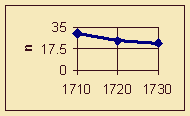
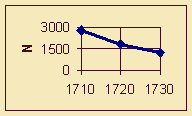
NUMBER OF COMPOSERS (n) and the total NUMBER OF LINES devoted to them (N)
were calculated. The last value (N) seems to be the indicator of the
INTENSITY of musical life. After the analysis two hypotheses were put forward:
1. If the number of authors (n) serves as a factor of
«popularity» or «prestige» of a particular kind of art in the professional
artistic environment, there should be an
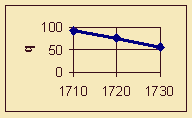
indicator of «quality of intensity» - the «average mastery». This parameter is
SPECIFIC INTENSITY q: q(t)=N(t)/n(t).
2. Changes in the intensity of artistic life have to be regarded as a
dynamic process: each generation of authors keeps in mind the experience of the
previous generation.
|
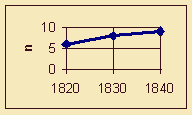
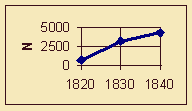
|
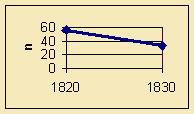
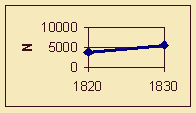
|
|
|
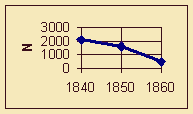
a) RISE (Russia)
|
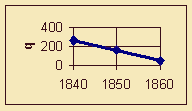
c) ACCUMULATION (Austria and Germany)
|
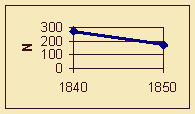
e) EXTERNAL GROWTH (Denmark)
|
|
|
|
|
| a) DECLINE (Italy) |
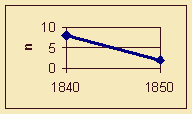
d) DISSIPATION (Czechia)
|
f) EXTERNAL DESTRUCTION (Sweden)
|
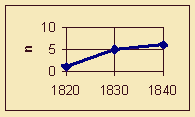
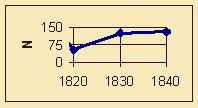
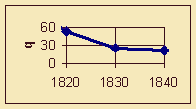
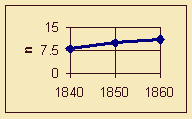
So, there are six versions of three changes in the intensity parameters
(n, N and q) (Fig. 1a-f), which can be illustrated with
the data on 4511 composers belonging to 17 national schools of music of the
XVIIth-XXth centuries [in each case the upper curve responds to the number of
authors (n), which is followed by the number of lines (N), and
the value of the specific intensity (q)]:
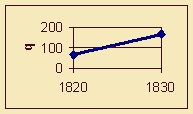
a) n up, N up, q up - RISE. This way usually
describes the creation of a national school. The given kind of art becomes
popular in the professional artistic environment, the internal resources and mastery
increase. So the potential of the national school is rather high. Example: Russia,
1830-49 (here and later birthdates of authors are
meant).
b)
n down,
N down,
q down -
DECLINE. If this version of change in the intensity
parameters continues for a long time, the potential of the national school is
likely to be exhausted. Then, if any sources (internal or external) are not
found, the national school disappears surely. Example:
Italy,
1720-39
c)
n down, N up, q up - ACCUMULATION. The national school resists
«author-replication» and so makes its potential raise. Popularity decreases,
but this raise of the potential provides for one more RISE. Usually, the first
one has already been before this period. Example: Austria
and Germany,
1830-39.
d) n up, N down, q down - DISSIPATION. After major
achievements of the national school, the popularity of the given kind of art grows
rapidly (at the expense of the internal potential exhausting). Example: Czechia, 1850-69.
e)
n up, N up, q down - EXTERNAL GROWTH. The internal potential of the
national school decreases, but the intensity grows. This fact can be explained
only by influence of another national schools, kinds of art or other external
causes (Denmark, 1830-49).
f) n down, N down, q up - EXTERNAL DESTRUCTION. The national school
accumulates its internal resources, but popularity of the kind of art declines.
So there are some external causes (political, religious, social, cultural,
etc.) that refuse the successful development of the national school (Sweden,
1850-59).
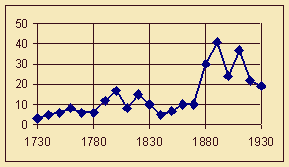
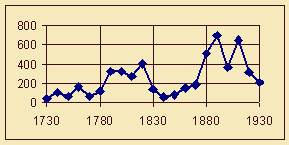
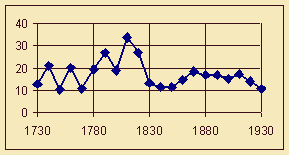
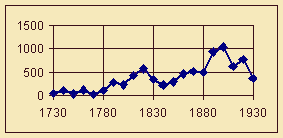
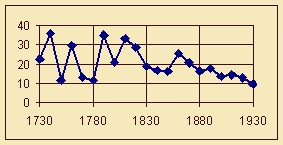
The analysis of these three parameters of intensity of
RUSSIAN ARTISTIC LIFE revealed the following conclusions illustrated with Fig.
2-4:
|
|
 |
|
Figure 2. Evolution of
Russian poetry
|
Figure 3. Evolution of
Russian prose
|
|
|
|
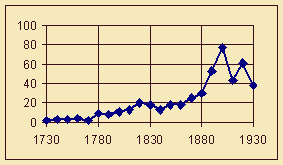
Figure 4. Evolution of
Russian music
|
1. Before 1795 changes in all three intensity parameters both of
prose and poetry are the same. It's likely to mean that there was no
distinction between poets and prosaic writers in Russia at that time.
2. 1775-1799. Russian poetry, prose and music experience a
RISE.
3. 1805-1819. Russian poetry deteriorates as a result of
external causes (EXTERNAL DESTRUCTION), so it virtually vanishes after 1845.
4. A RISE in Russian prose (1805-1819) provides for
another one (1845-1869).
5. From 1805-1819 the changes in the intensity parameters
in prose are different from those ones in poetry (unlike the period before 1795).
So Russian literary authors start to distinguish themselves either as
prose-writers (N. Gogol', I. Turguenev)
or poets (F.Tyutchev, E. Baratynsky,).
6. Russian music in 1805-1819 and literature in 1820-1829
experience EXTERNAL GROWTH. The external cause of this growth was «realism» as
a popular artistic method (A. Dargomyzhsky, A. Ostrovsky, N.
Nekrasov, F. Dostoevsky, M. Saltykov-Shchedrin, N. Tchernyshevsky, L.
Tolstoy).
7. After 1840 the intensity of musical life presents itself a
self-organizing system: RISE - DISSIPATION - ACCUMULATION - RISE (Example:
P. Tchaikovsky, N. Rimsky-Korsakov - A. Lyadov, S. Taneyev - A. Glazunov,
A. Arensky, A. Scriabin, S. Rakhmaninov - N. Myaskovsky, I. Stravinsky).
8. The entire evolution of intensity of Russian
literary life is (excluding RISES) only affected by external causes.
References
Martindale, C. (1990). The Clockwork Muse: The Predictability of
Artistic Change. New York:
Basic Books.
Petrov, V.M., & Majoul, L.A.
(2002). Pulsation of literary life: Periodical behavior of Russian poetry and
prose in light of the information approach.
Rivista di Psicologia dell'Arte, Nuova Serie, Anno XXIII, No. 13, 25-40.
Все права защищены © EN-PETER.KULICHKIN.RU, 2008.