"Degenerated" Cases of Tensity Function and the Degree of Genre Characteristics Expression in i Musical Piece (Experiments of Quantitative Analysis Applied to Pianoforte Miniatures of 18th-20th centuries)
In musical science the key notion
linking historically established types and species of musical products with
means and terms of their performance and perception is genre. In the framework
of such an approach genre of music becomes the principal component of music's
«genetic code» and succession carrier in the process of historic development.
Genre's fundamentals, first and foremost -motion, declamation and singing - are
expressed in this or that way in any theme of any
piece of music. As a rule, the impact of genre's fundamentals on form
and content parameters of music is assessed intuitively. At the same time today
there exists a mathematical toolset to adequately describe cases with various
types and degrees of uncertainty - that is, the theory of Fuzzy sets (Zadeh,
1965). In relation hereto it is interesting to consider the issue of
quantitative presentation of the genre characteristics expression in music.
In this research the impact of motion is
considered, concerning the characteristics of tensity function in musical
pieces of XVIII-XX centuries. Sixty-one randomly selected pianoforte miniatures,
belonging to the so-called «program» music, were processed. The tensity
function in each piece was determined as Fuzzy
set FN = (FP, HP, RP),
where FP, HP and RP are Fuzzy sets describing the number of texture,
harmony and rhythm «events» per time unit (their density):
where
the <Average
density> is a function of interval contents, intensity and register.
The density of rhythmic events was
determined using the quantity of attacked sounds,
the density of harmonic events - based on the number of accord changes, and the
density of texture events — as an average degree of accords'
consonance/dissonance (see also Zubareva, 2002; Kulichkin, 2002).
|
|
| Figure 1a. J.S. Bach. Preludio I. Rhythmical pattern |
|
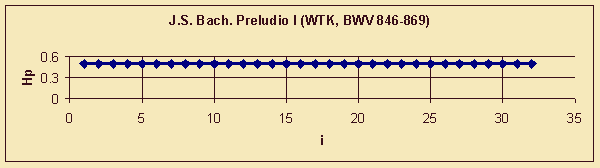
Figure 1a. J.S. Bach. Preludio I. Harmonic Density
|
|
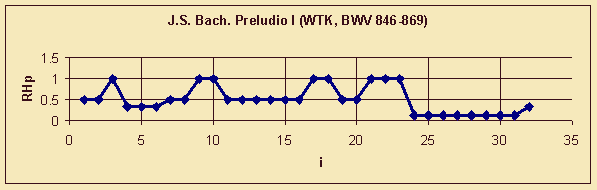
Figure 2. J.S. Bach. Preludio I. Diagram of density of rhythm and harmony events.
|
|
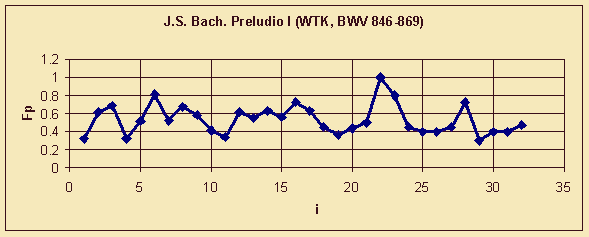
Figure 3. J.S. Bach. Preludio I. Diagram of density of texture events.
|
Let us demonstrate this approach to
the interpretation of results on the example of Preludio I from Volume 1 of
J.S. Bach's «Well-Tempered Clavier» (Fig. 1-3). In 32 beats out of 35 two of
three parameters (HP and RP) are constant values
(Fig. 1). At the same time, there is a
development of an independent rhythm and harmony process, which is expressed
through interchange of sound events in the bass voice (Fig. 3).
The comparison of curves' profiles
in Fig. 2 and Fig. 3 reveals their central symmetry over i=14. There are four
maximums of the rhythm and harmony curve, the utmost being synchronic with the
maximums of the texture curve, and the intermediate one being complementary to
the texture ones. The discovered symmetry may be attributed to the statics of
«continuing state», modelled by the composer in this piece. At the same time,
the dynamic forces are also active in the Preludio; they reveal themselves in
the culmination value of the texture density in the beat 23, as well as in the
higher event saturation of the rhythm and harmony process after the central
symmetry point, providing for the preparation of the following Fugue.
Having analyzed the 61 diagrams of
the pianoforte piece, we came to the following conclusions:
1) In the miniatures where motion component
dominates, one of three tensity parameters is «degenerated», i.e. constant
throughout the whole piece or its section, or
- which is actually the same in mathematical terms - strictly periodic. Texture
density less often turns out to be such parameter, which may be attributed to
the artistic target of expressing motion. In
this case the role of texture density becomes decisive in setting the climax;
2) «Degeneration» of one parameter is
especially pronounced in «utile» samples of music, receding alongside with
«erosion» of links between themes and genre protoplast;
3) The impact of tensity function (and its
elements) on the degree of genre characteristics expression may be defined as
dispersion of «degenerated» parameter: the less the dispersion, the higher the
degree of impact.
4) The rare case of degeneration of two of the
three density parameters evidences the lack of coincidence between the motion
processes of the foreground and the background temporal statics. This
correlates well with the theoretic notion of the presence of several levels in
musical forming.
The results obtained allow us to attribute the
analyzed parameters to a general phenomenon studied by various sciences. Thus,
physiological data evidences high density of internal apprehension,
while linguistics proves the important role of informational density in the
conceptual execution of new knowledge. It is quite possible that the examined
changes in density of sound events and their consequence, i.e. changes in
tensity, belong to the universal means of coding any information (biological,
scientific, aesthetic, etc.).
References
Kulichkin, P.A. (2002).
About researching one's own work (http://en-peter.kulichkin.ru/artic/aboutres). In: Bulletin of Psychology and the Arts. Vol.
3, №2, 53-54.
Zadeh, L.A. (1965). Fuzzy sets. In: Information
and Control Systems. Vol. 8, 338-353.
Zubareva, N.B. (2002).
Tochnye metody v issledovaniyi protsessov musykal'nogo formoobrazovaniya. In:
V.V. Malanin (Ed.), Istoriya I metodologiya nauki (pp.94-103). Perm: Perm
State University.
[Quantitative methods in research of musical form].
Все права защищены © EN-PETER.KULICHKIN.RU, 2008.